Off the Syllabus: Mapping the Thriving Underground of English Shayari Performance Across America
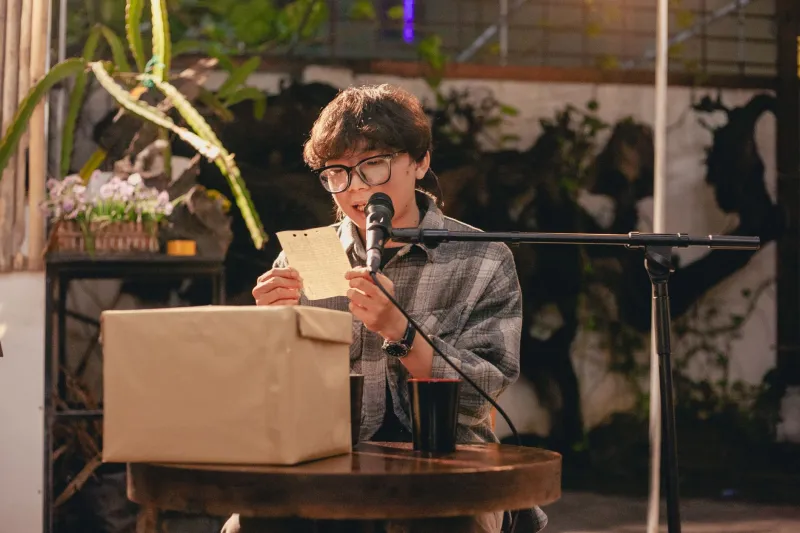
On a Tuesday evening in late autumn, a dimly lit restaurant in Chicago's Devon Avenue corridor — a stretch of South Asian businesses that locals have called the city's desi main street for decades — fills beyond its usual dinner capacity. Tables are pushed toward the walls. A microphone stand appears near the kitchen door. By 7:30 p.m., nearly sixty people are standing along the perimeter, holding chai and waiting.
What follows over the next two hours is not a poetry reading in any conventional sense. There are no podiums, no event programs, no institutional affiliations announced. There is, instead, a rotating series of voices — some polished, some raw, some speaking from folded notebook paper, some from memory — offering sher after sher in English, occasionally slipping into Urdu or Punjabi for a single word that cannot be replaced. The audience responds the way audiences at mushairas have always responded: audibly, immediately, with a rolling murmur of recognition when a couplet lands.
This is English Shayari in America. And almost none of it is happening in the places the literary world thinks poetry happens.
The Institutions Are Not Watching
America's poetry establishment — its MFA programs, its major literary journals, its festival circuits, its National Book Award committees — has developed a reasonably sophisticated awareness of the ghazal as a form. Agha Shahid Ali's advocacy, Marilyn Hacker's translations, and a small number of celebrated practitioners have secured the form a footnote in the contemporary canon. What the establishment has largely failed to notice is the scale and vitality of the performance ecosystem that has grown up entirely outside its orbit.
The venues sustaining English Shayari in the United States are not, in most cases, the venues where literary culture expects to find itself. They are South Asian restaurants hosting monthly mehfils. They are university student lounges organized by Pakistani Student Associations and Indian Cultural Clubs with no faculty oversight. They are independent bookstores in cities with significant South Asian diaspora populations — Edison, New Jersey; Fremont, California; Sugar Land, Texas — that have discovered poetry events bring in communities that traditional author readings do not.
They are, occasionally, music venues where Shayari shares a bill with ghazal singers, creating an evening that feels less like a literary event and more like the mushaira tradition it descends from: communal, interactive, built around the pleasure of listening together.
Houston: Where the Restaurant Became the Stage
In Houston — home to one of the largest South Asian populations in the American South — a loose network of organizers has sustained regular English Shayari events for several years through a model that requires no institutional support and generates no institutional recognition. Events are announced through WhatsApp groups, Instagram stories, and the kind of word-of-mouth that moves faster through a tight community than any press release.
"We tried to get a grant once," says one organizer, who asked to be identified only by her first name, Sunaina. "The application asked us to describe our 'institutional partners.' We didn't have any. We had a restaurant owner who believed in us and a group chat with four hundred people in it. That turned out to be enough."
The Houston events typically draw between forty and eighty attendees, a figure that would be considered a significant success for a poetry reading at a major university. The audience is multigenerational — second-generation South Asian Americans in their twenties alongside their parents' generation, alongside non-South Asian poetry enthusiasts who found the events through social media. The work performed ranges from formally rigorous ghazals to looser English Shayari that borrows the emotional vocabulary of the tradition without adhering strictly to its structural requirements.
New York: The Warehouse and the Living Room
New York's English Shayari scene is, predictably, more diffuse and more self-consciously experimental. In Brooklyn and Queens — both home to substantial South Asian communities — events tend to be smaller and more intimate, often organized in private apartments or shared creative spaces rather than commercial venues.
Amara Khan, a poet based in Astoria, has been hosting what she calls a "gathering" — deliberately not a reading, not a salon — in her apartment every six weeks for the past three years. The guest list hovers around twenty. Attendance is by invitation, extended through a network that has grown organically from a single text message sent to eight friends.
"The word 'performance' does something to people," Khan explains. "It makes them think about audience and presentation. What we do is closer to what a mushaira was originally — a gathering of people who love this form, reading to each other. The intimacy is the point."
Elsewhere in the city, larger events have found homes in music venues in Ridgewood and Jackson Heights, where the overlap between South Asian musical performance and Shayari creates evenings that resist easy categorization. These are not open mics. They are not concerts. They are something the American entertainment industry does not yet have a proper label for, which may be precisely why they have flourished outside it.
The Bay Area: Campuses as Unlikely Incubators
In the San Francisco Bay Area, university campuses have emerged as unexpected infrastructure for the English Shayari scene — not through official literary programming, but through student organizations operating with minimal administrative involvement. At UC Berkeley, Stanford, and San Jose State, South Asian student groups have organized Shayari events that draw audiences well beyond their membership, creating a pipeline of young practitioners who arrive at college with some exposure to the tradition and leave having deepened it considerably.
"The university gave us a room and a budget for snacks," says Raza Mirza, a recent Berkeley graduate who helped organize events there. "Everything else we did ourselves. We found the poets, we set the format, we decided what English Shayari meant in our context. Nobody from the English department ever showed up, which was honestly fine."
This independence from institutional oversight has allowed campus Shayari events to be formally adventurous in ways that more established literary venues might not permit. Performers experiment with mixing English and Urdu within single couplets, with responding to each other's work in real time, with formats that blur the line between performance and conversation.
What Publishers Are Missing
The most striking feature of this ecosystem, viewed from any distance, is how effectively it has sustained itself without the validation — or the revenue — that traditional literary institutions provide. There are no book deals emerging directly from these events. There are no festival invitations, no reviews in major publications, no teaching positions offered on the basis of a reputation built in a Houston restaurant or a Brooklyn apartment.
And yet the scene persists, grows, and generates the kind of genuine audience engagement that most literary institutions spend considerable resources trying to manufacture.
The publishers and festival programmers who have not yet found their way to these rooms are not missing a trend. They are missing a tradition — one that predates the American literary industry by centuries and has no particular need of its approval. English Shayari's underground is not underground because it has failed to achieve visibility. It is underground because it has not needed to surface.
The question, for the literary establishment, is whether it will find its way to these rooms before the rooms stop waiting.