What the Silence Was Holding: How Shayari Unlocks the Unspoken Distance Between Immigrant Parents and Their American-Born Children
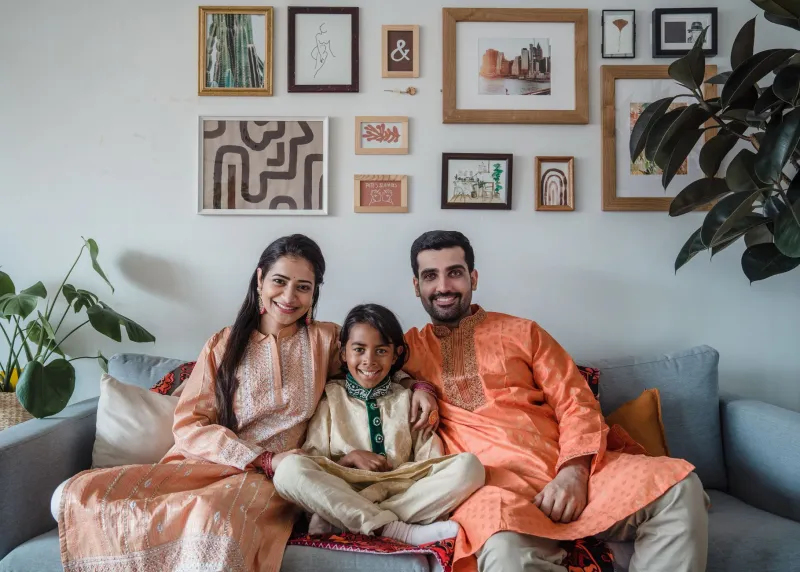
There is a particular kind of quiet that lives inside South Asian immigrant households in America. It is not the quiet of peace. It is the quiet of things that happened before — before the visa, before the flight, before the new ZIP code — and were never given a proper name in the language the children grew up speaking. For families shaped by Partition, by economic migration, by the particular grief of leaving everything familiar behind, silence became a form of survival. What Shayari is now revealing, in English and in the hands of a new generation, is that this silence was never empty. It was full.
The Inheritance Nobody Explained
Rukshana Mirza was thirty-one years old when she first read an English-language couplet online that stopped her mid-scroll. The verse, composed by a Pakistani American poet based in Houston, described the act of watching a parent grow old in a country that never fully recognized them — the particular sorrow of seeing someone's dignity diminished not by age alone but by foreignness. "I sent it to my mother," Mirza recalls. "She read it and didn't say anything for a long time. Then she said, 'Who wrote this? How did they know?'"
That question — how did they know? — is one that surfaces repeatedly in conversations with South Asian American families navigating the emotional terrain between generations. The parents, many of whom arrived in the United States during the 1970s, 1980s, and 1990s, carried with them a cultural literacy steeped in Urdu literary tradition: the ghazal, the nazm, the couplet as a vessel for emotion too large for ordinary speech. Their children, raised in American schools and shaped by American idiom, often had no access to that tradition except as something distant, ornamental, occasionally heard at weddings or during Eid. The connective tissue was missing.
English-language Shayari, as it has evolved across diaspora communities in cities like Chicago, Atlanta, and the Bay Area, is beginning to function as precisely that tissue.
A Couplet Does What a Conversation Cannot
Dr. Anwar Siddiqui, a retired civil engineer living in suburban New Jersey, emigrated from Lahore in 1983. His daughter, Nadia, is a high school English teacher in the same state. By her own admission, they have always loved each other and rarely understood each other. "He would try to explain something about his childhood, about what it was like during certain years in Pakistan, and I would listen, but I couldn't feel it," she says. "There was always a wall. I thought it was a language wall."
It was not only language. It was form. The emotional grammar of her father's interior life had been shaped by a poetic tradition in which restraint and indirection were not evasions but refinements — where the most devastating truth arrived sideways, through metaphor, through the architecture of a well-turned couplet. Direct speech, the mode Nadia had been trained in since kindergarten, was not his native emotional register.
Last year, Nadia began writing her own Shayari in English, initially as a private exercise and eventually as a submission to an online literary journal focused on diaspora writing. One of her couplets read:
He crossed an ocean to give me everything he had. I spent my whole life wondering why he seemed so far away.
When she showed it to her father, he wept. "He said that was exactly it," she recalls. "He couldn't have said it himself. But he recognized it immediately."
This is what literary scholars and family therapists who work with immigrant communities describe as the "recognition function" of poetry — the capacity of a well-crafted line to surface an emotion that the reader already carries but has never been able to articulate. In South Asian households where emotional directness was historically discouraged, particularly among men of a certain generation, this function is not decorative. It is therapeutic in the most fundamental sense.
The Form as Family History
It is worth pausing to consider why the Shayari form, specifically, carries this weight. The couplet's compression — its demand that the poet distill an entire emotional reality into two lines — mirrors the conditions of immigrant experience itself. Everything essential must fit into what can be carried. Nothing extraneous survives the crossing. The beloved in classical Shayari is famously absent, longed for, approached but never fully reached. For the children of immigrants, the beloved is often the parent as they might have been in another life, in another country, before the losses that shaped them into who they became in America.
Several poets working in the English Shayari tradition have spoken about this explicitly. Farrukh Aleem, a poet and educator based in the Chicago area whose work has been featured in diaspora literary spaces, describes his practice as an act of "reverse archaeology." He writes toward his parents' silences, using the couplet as an instrument for excavating what was buried not out of shame but out of necessity. "My father never talked about leaving Karachi," he explains. "Not because it didn't matter. Because it mattered too much. The Shayari form gave me a way to honor that — to write about enormous things in a small, careful space."
When the Children Become the Translators
There is an irony embedded in this phenomenon that is not lost on the families living it. In most immigrant households, the children serve as linguistic translators for their parents — navigating bureaucratic English, medical appointments, tax forms. The parent is the one who carries the cultural knowledge; the child is the one who carries the language. English-language Shayari inverts this dynamic in a striking way. Here, it is often the American-born child who has learned the poetic form and is now offering it back to the parent — translating the parent's own emotional inheritance into a tongue the parent never expected to find it in.
For some parents, this is disorienting. For others, it is a kind of homecoming.
"My mother always said Urdu was the language of feeling," says Mirza, the woman whose mother asked how did they know? "She didn't think English could do what Urdu did. When I started writing Shayari in English and showing it to her, she changed her mind a little. She said, 'Maybe the feeling is the same. Maybe it was always about the feeling.'"
The Bridge Is Still Being Built
None of this is to suggest that a couplet can resolve what decades of distance and displacement have complicated. The families who are finding their way toward each other through English-language Shayari are not claiming that poetry heals all wounds. They are claiming something more modest and, in many ways, more profound: that it names them. That naming, in a tradition as ancient and as carefully wrought as Shayari, is not a small thing. It is the beginning of being known.
At Best English Shayari, we have long believed that this form speaks to something the English language has not always been asked to carry. What these families are discovering, one couplet at a time, is that English is capable of more than it has been given credit for — and that the soul of Shayari, wherever it travels, retains its essential power to illuminate what the silence was holding all along.