The Sangeet Reads a Couplet Now: English Shayari's Rise in American Desi Weddings
Photo: wedstories.studio, CC BY-SA 2.0, via Wikimedia Commons
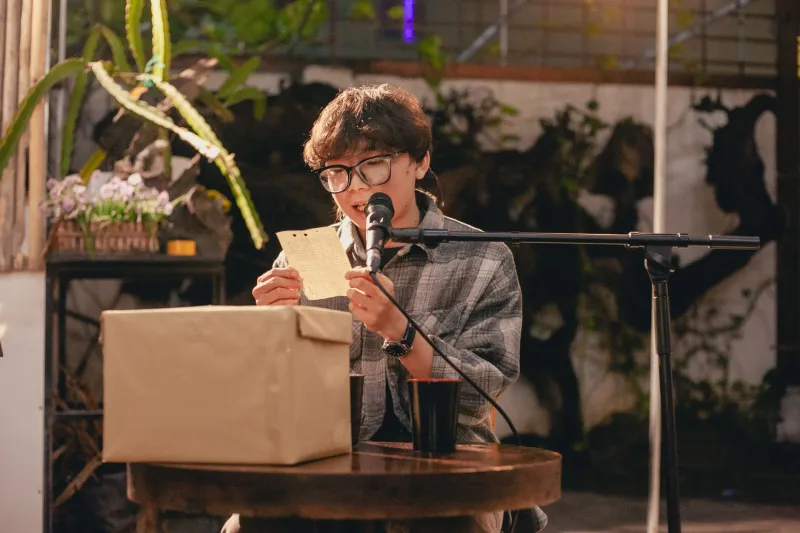
The sangeet is in its second hour at a banquet hall outside Edison, New Jersey, and the microphone has already been passed three times. A cousin has performed a choreographed number. An uncle has given a speech that ran long. Then the bride's younger brother takes the mic, unfolds a single index card, and reads four lines in English — a small ghazal, two couplets and a closing signature, about two families learning to say each other's names correctly.
The room goes quiet in a way the dance floor had not managed all evening.
“That was the moment we realized what we had been trying to do all along,” says the bride, who married in September 2026. “We had two hundred guests and about sixty of them spoke Urdu. English shayari was the only form we knew that could hold both halves of the room at once.”
How the Couplet Got Invited
American desi weddings have always been translation projects. Programs print the order of the Sikh or Hindu ceremony in two scripts. Aunts explain the mangalsutra to college roommates. The DJ is instructed to alternate Bollywood and Top 40 by a ratio no one has ever written down.
What has changed, planners say, is the arrival of a poetic register that travels without a translator. English-language shayari — the ghazal's architecture carrying English syntax — has moved over the past several years from the obscure corner of a bilingual program to a genuine feature of the reception itself.
“Five years ago, if a couple wanted a reading, we offered Rumi, and everyone nodded politely,” says a wedding planner in Dallas who has coordinated South Asian ceremonies since the early 2010s. “Now the couple sends me a PDF. Sometimes it is a published poet. Sometimes a friend wrote it. Occasionally it is a line from an Instagram post that they made everyone agree to credit properly — which, honestly, is my favorite outcome.”
The Paper Trail
The most common entry point is not the stage at all. It is the stationery.
Mehndi and haldi invitations have become a quiet home for the form: a single couplet at the top of a card, set in gold, above the address and the RSVP line. Planners describe a useful format — four lines maximum, no more than twelve syllables per line, one clear image, and the refrain kept short enough to fit on a five-inch card without shrinking the font below polite.
Come for the henna, stay for the noise — two families are learning each other's names tonight.
The temptation is to overreach. An invitation is not an elegy; it has a job to do, and that job is to tell a hundred people where to park.
The Ceremony Reading
The second, and more demanding, home is the ceremony itself. A reading of ninety seconds to two minutes, delivered after the vows or between ritual steps, is now common enough that several officiants in the New York and Chicago areas have started keeping a folder of favorites.
“I ask every couple the same question,” says an officiant who performs interfaith ceremonies in Queens. “Is this for you, or is this for the relatives? The answer changes the poem entirely. If it is for the couple, it can be private and strange. If it is for the room, it needs a door that everyone can walk through.”
Two doors, one threshold. We will not ask which of us is the house and which the key.
The Toast, Rewritten
Reception speeches are where English shayari has made the most visible difference — and where it can go wrong most spectacularly. A cousin reading beneath a chandelier has roughly the same amount of time as a pop song and less goodwill than a dance number.
Poets who take commissions for weddings describe a consistent brief: not romantic, exactly. The couple already has romance. What the family wants is something that can name the migration — the parents who came in 1987, the grandmother who did not, the food that survived when the rest did not — without turning the room into a lecture.
Whatever our mothers forgot to translate, we are saying it now, out loud, in the same room.
Explaining the Form to the American Half of the Room
Planners offer a piece of practical advice that poets tend to agree with: introduce the form in one sentence, or not at all.
“The temptation is to give a masterclass from the microphone,” says a poet in the Bay Area who has read at four weddings since 2023. “Do not. Say the couplets. Let people feel the repetition land. The radif does the explaining for you — by the third time they hear it, the whole room knows the rule, and they are waiting for it.”
The mechanics of reception that work best, according to both planners and poets:
- Keep it under two minutes. A ghazal reading on a wedding stage is not a poetry reading.
- Print it. Programs with translation notes — or just a transliteration line — flatter your guests and settle arguments.
- Credit the poet. Name the writer in the program, or in one clause: “a ghazal by —.” Even if the poet is a cousin.
- Avoid the ornamental trap. Line readings that treat Urdu culture as scenery rather than inheritance tend to age badly and read as costume. The form is intimate; the room should feel close to it, not touristy in front of it.
- Match the moment. A mehndi invitation wants brightness. A ceremony wants stillness. A toast wants a laugh and one turn.
What the Couplet Actually Does
Underneath the logistics sits a simpler explanation for the form's popularity in 2026: it is the only thing at an American desi wedding that can address a mixed room in a mixed language and remain, unapologetically, one utterance.
“I didn't grow up fluent,” one groom in San Jose puts it. “I know enough Urdu to feel the shape of a sher and not enough to be sure of it. Writing it in English isn't a compromise. It's the first time I've been able to stand in the tradition without pretending.”
His reading ran ninety seconds. His mother's family cried anyway.