The Radif Belongs to Everyone Now: How American Slang, Dialect, and Vernacular Are Rewriting Shayari's Sonic Vocabulary
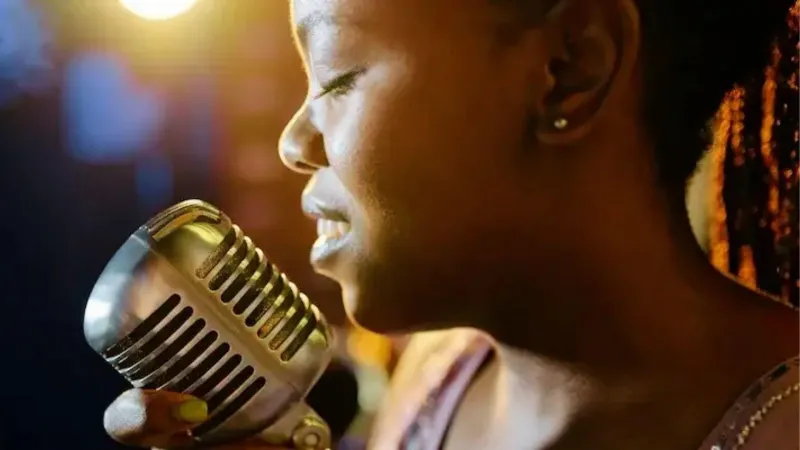
Photo: diverse poets spoken word performance microphone urban stage, via rememberedlore.com
The word "radif" does not appear in most American poetry textbooks. In the classical Shayari tradition, it refers to the refrain — the repeated word or phrase that anchors each couplet's second line in a ghazal, giving the poem its sonic spine and its philosophical center. For centuries, poets writing in Persian, Urdu, and Arabic deployed the radif with extraordinary precision, understanding that the word chosen to recur would accumulate meaning with every repetition, growing heavier and stranger as the poem progressed.
Now consider the following: a radif built around the word "lowkey." Or "no cap." Or "finna." Or, in one memorable recent piece circulating in English-language Shayari communities, the phrase "it's giving."
If your first instinct is to find this incongruous, you are responding to something real. If your second instinct is to find it inevitable, you are also right.
The Form Has Always Fed on the Living Language
The history of Shayari is, in part, a history of forms absorbing the linguistic textures of the cultures they moved through. The ghazal that arrived in South Asia was not the ghazal of pre-Islamic Arabia. The Urdu ghazal that flourished in Mughal court culture absorbed Persian vocabulary, local idiom, and the particular social preoccupations of its moment. Poets like Mir Taqi Mir and Ghalib were not antiquarians preserving a dead form; they were writers using a living structure to say things that mattered urgently in their own time and place.
English-language Shayars working in the United States are operating in the same tradition, even when — especially when — the linguistic material they are working with looks nothing like what came before.
"The radif is a vessel," says one poet based in Atlanta who has been writing ghazals with refrains drawn from African American Vernacular English for several years. "People forget that. They think the form is the content. But the form is the container. What you put in it is your responsibility as a writer, and my responsibility is to put in what is real to me, what sounds like the world I actually live in."
What Happens When the Refrain Speaks Differently
The decision to build a radif from vernacular, slang, or regional dialect is not merely an aesthetic choice. It is, in the context of a poetic tradition with deep roots in South Asian literary culture and a long history of formal prestige, also a political one.
For Black American poets engaging with Shayari — and there is a growing, if underacknowledged, community of them — the use of AAVE as formal material is a direct challenge to the hierarchies that have historically governed which linguistic registers are considered worthy of serious literary form. The ghazal, by virtue of its classical pedigree, carries a certain cultural authority. When that authority is inhabited by language that has been systematically devalued in American literary and educational institutions, the collision produces something worth examining carefully.
"There's a reason we call it code-switching," says one spoken word artist and Shayari practitioner from Houston who writes ghazals that move between formal diction and the vernacular of her Houston neighborhood. "When I write a radif in the way my grandmother talks, I'm saying this language belongs in this form. I'm saying the form is big enough. I'm saying my grandmother's voice is precise enough, is musical enough, is serious enough."
Similar dynamics are at work among poets drawing on Southern American dialects — the particular vowel elongations and syntactic inversions of Appalachian speech, for instance, or the Creole-inflected cadences of Louisiana English. These are not accidental choices. They are acts of linguistic assertion.
Silicon Valley and the Jargon Ghazal
Not all vernacular appropriation in English-language Shayari carries this weight of reclamation. Some of it is more playfully subversive.
A small but notable subset of poets — many of them South Asian Americans working in or adjacent to the technology industry — have begun building ghazals around the particular verbal tics of contemporary professional culture. "Scalable," "pivot," "bandwidth," "disrupt" — terms that began as technical vocabulary and have metastasized into a kind of corporate lingua franca — have appeared as radif in recent work that uses the ghazal's philosophical framework to interrogate the values embedded in this language.
The effect is often darkly comic. A ghazal whose every couplet ends with "at the end of the day" — a phrase so emptied of meaning through overuse that it has become a kind of verbal static — forces the reader to hear it again, freshly, twenty times in succession. The radif's function is to accumulate meaning, but it can also accumulate absurdity, and in that accumulation, something critical emerges.
The Question of Theft and Reclamation
The phrase "rhyme thieves" is provocative for a reason. When poets from one cultural tradition borrow sonic material from another, questions of ownership and respect legitimately arise. An English-language Shayar who is not from a community that speaks AAVE building a radif from AAVE phonetics is engaged in a different act than a poet writing from within that community.
These distinctions matter, and the English-language Shayari community is not uniformly agreed on where the lines fall. What seems clearer is that the conversation itself — about which languages belong in formal poetry, about who gets to authorize that belonging, about what it means to use someone else's vernacular as artistic material — is one that the ghazal form, with its long history of cross-cultural transmission, is unusually well-equipped to host.
The radif, after all, is not a fixed inheritance. It is a structural invitation. Every poet who sits down to write a ghazal must decide what word, what phrase, what sound will anchor the poem's return. That decision is never neutral. In the hands of American poets writing in English, it has become one of the most revealing choices in contemporary verse — a small formal decision that opens onto enormous questions about language, belonging, and the right to be heard.